Why I believe a STEM phd is worth it from a business perspective
In no particular order...
-
PhD is a superset of many non-technical functions. A PhD can become a CEO, a partnerships lead, a marketing master, etc., but the opposite transition is much harder. Business skills can be learned on the job; frontier technical depth is harder to acquire on the fly
-
As the cost of intelligence goes down, the value of real understanding may polarize. Assuming AI can't do everyone's job and requires expert supervision, those posing as knowledgeable will fail while those with enough understanding to recognize when AI is wrong will be rewarded
-
Deep understanding may soon be scarce. Reliance on AI is reducing the incentive for students to learn concepts fully
Alternative opinion: AI democratizes knowledge. Unfortunately, my personal experience is that AI teaching is not as good as industry or classes.
-
The ability to adapt and learn will be valuable. A PhD (supposedly) teaches you how to learn. Doing math problems makes your technical brain faster
-
The world is brutal (and very gatekeepy). Businesses are incentivized to keep employees working on their highest value-add. Without a step-function change in your skillset, you are likely stuck working on the same thing.
-
The supply of the vibe-coder increases. AI will aggregate this demographic ~ smart non-technical people coding better than most engineers, PMs, and engineers who didn't quite understand the material ~ as their required skillsets merge around one thing: the ability to prompt AI smartly
-
The supply of the business operations expert increases. The current field of ex-bankers, consultants, MBAs, business-leaders, and early startup employees will either compete here or become vibe-coders
-
There are more Steve Wozniak’s than Steve Jobs. Absolute demand for technology in a technology-driven world is greater than demand for the people directing them
Summary:
- Easier to go from a PhD skillset to a business skillset than vice versa
- Deep understanding is a bottleneck (aka demand up) unless cognitive labor is almost entirely automated (aka we are all screwed because AI can do everyone's job)
- Assuming a good PhD is a reliable way to build deep understanding, the supply of deep technical understanding may grow more slowly than demand (aka relative supply down)
- Other careers will merge as AI commoditizes generalist capabilities (aka effective supply up, demand TBD)
Think of AI as combining the world's jobs. One blob for the vibe-coders. One blob for the business operations experts. One blob for the specialized soft skill folks, like sales, influencers, marketers, etc. One blob for the specialized PhDs. One blob for the physical labor (before the robots come).
Note: the vibe coder name is deceiving because it is not just software engineering. If someone with no knowledge of finance can prompt AI into generating a model, then that counts too. Every white collar job will become a “vibe coder.”
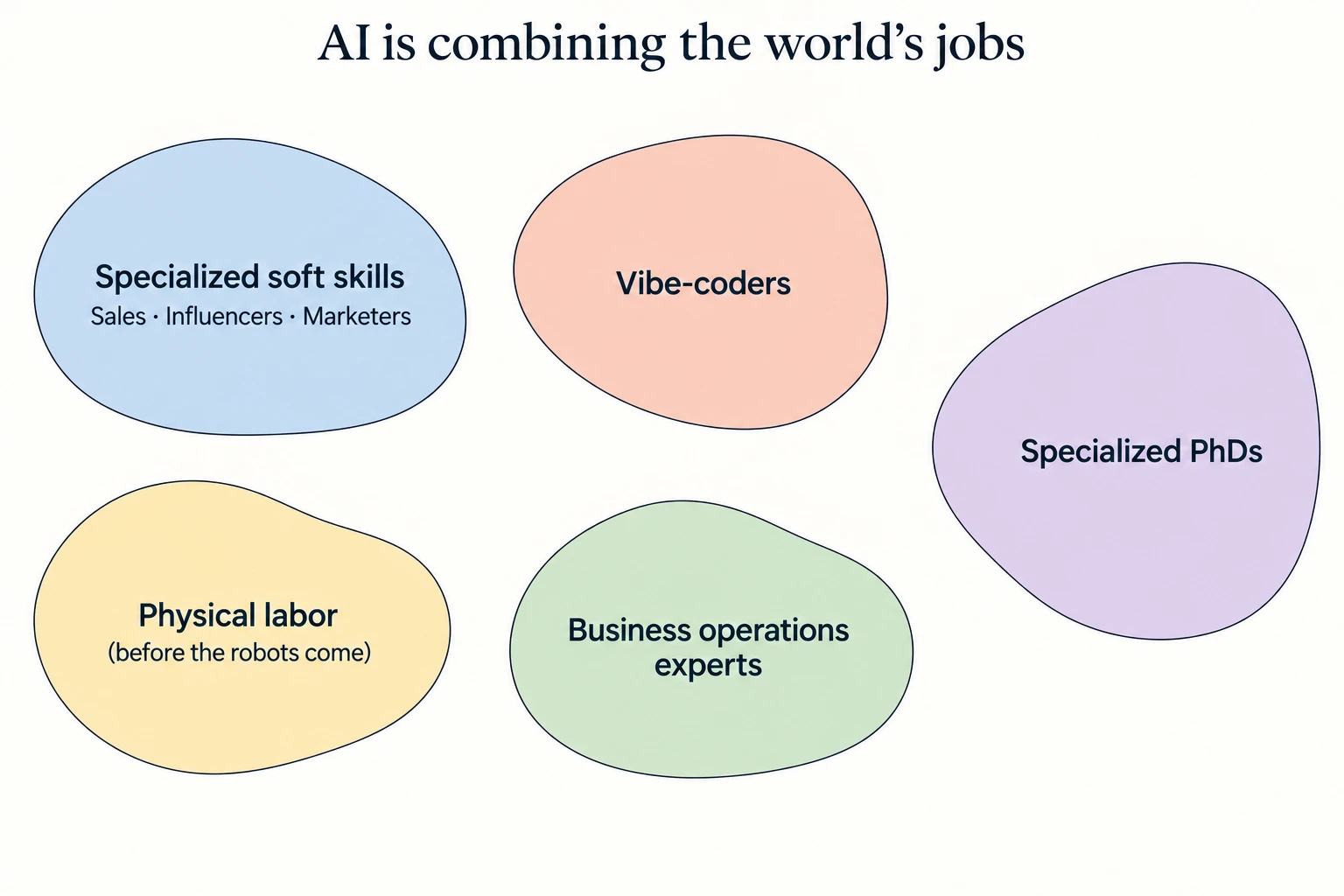
The real question is: where do you want to be 10, 20, 30, 40, 50 years down the line. The subset or the superset? Low supply or high supply? Low demand or high demand? What game do you want to play?